Unless stated otherwise, my source for hymn texts and tunes is The Lutheran Service Book.

Sunday, November 19, 2023

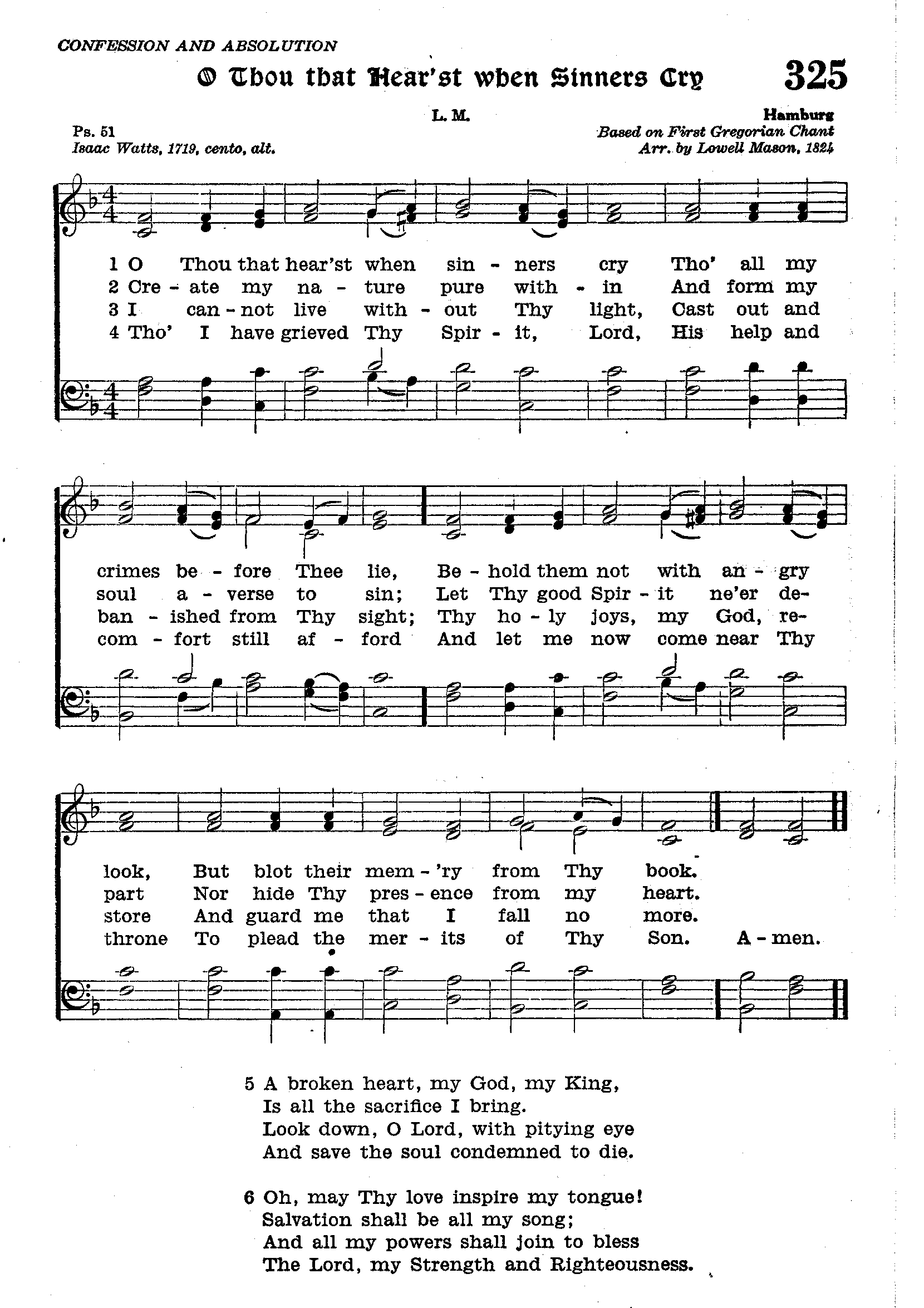
"Hamburg" (TLH #325)


I had new strings put on my mandolin, so this sounds a bit different.

Also, I discovered a mistake in the notation for this hymn.  At the end of the first phrase, the soprano and alto parts each have a whole note, but in the tenor and bass parts, there are only half notes.  Here's a scan from hymnary.org:


Of course, these should be whole notes, too, and that's how I played them.

Friday, November 17, 2023

"Agnus Dei" (LSB #962)

A couple years ago, I noticed a small feature in "Agnus Dei" (LSB #962).  "Lamb of God, You take away the sin of the world" is sung three times, to two different musical phrases:


In both, "away" is sung with a melisma (G A C and G G C, respectively), giving a sense of distance or movement.

Wednesday, November 15, 2023

LSB #704 "Renew Me, O Eternal Light"

Biblical citations in the hymnal:  2 Corinthians 3:18, Colossians 3:1-10, Psalm 51:10-12

2 Corinthians 3:18:  "And we all, with unveiled face, beholding the glory of the Lord, are being transformed into the same image from one degree of glory to another.  For this comes from the Lord who is the Spirit."

Colossians 3:1-10:  "1 If then you have been raised with Christ, seek the things that are above, where Christ is, seated at the right hand of God.  2 Set your minds on things that are above, not on things that are on earth.  3 For you have died, and your life is hidden with Christ in God.  4 When Christ who is your life appears, then you also will appear with him in glory.

"5 Put to death therefore what is earthly in you:  sexual immorality, impurity, passion, evil desire, and covetousness, which is idolatry.  6 On account of these the wrath of God is coming.  7 In these you too once walked, when you were living in them.  8 But now you must put them all away:  anger, wrath, malice, slander, and obscene talk from your mouth.  9 Do not lie to one another, seeing that you have put off the old self with its practices 10 and have put on the new self, which is being renewed in knowledge after the image of its creator."

Psalm 51:10-12:  "10 Create in me a clean heart, O God, and renew a right spirit within me.  11 Cast me not away from your presence, and take not your Holy Spirit from me.  12 Restore to me the joy of your salvation, and uphold me with a willing spirit."

+++

The text is public domain:
1 Renew me, O eternal Light,
And let my heart and soul be bright,
Illumined with the light of grace
That issues from Your holy face.

2 Remove the pow'r of sin from me
And cleanse all my impurity
That I may have the strength and will
Temptations of the flesh to still.

3 Create in me a new heart, Lord,
That gladly I obey Your Word.
Let what You will be my desire,
And with new life my soul inspire.

4 Grant that I only You may love
And seek those things which are above
Till I behold You face to face,
O Light eternal, through Your grace.
+++

2 Corinthians 3:18 appears in the first verse, although there's a bit of overlap here with Colossians 3:10 and Psalm 51:10.

The first part of the text from Colossians 3 appears in the fourth verse ("And seek those things which are above"), and the second part seems to appear at the end of the second verse ("That I may have the strength and will / Temptations of the flesh to still").

The passage from Psalm 51 appears in the third verse.

The line "Till I behold You face to face" in the fourth verse seems to come from the first part of 1 Corinthians 13:12:  "For now we see in a mirror dimly, but then face to face."
Sunday, November 12, 2023

"Meinen Jesum lass' ich nicht" (TLH #324)


One of the strings on my mandolin broke, so I had to do the soprano and alto parts on guitar this week.

Friday, November 10, 2023

"Rejoice, My Heart, Be Glad and Sing"

I wrote about "Rejoice, My Heart, Be Glad and Sing" a couple years ago, but it was the hymn in a Concordia University Wisconsin chapel service I watched last month, and I noticed an-other small feature in it.

The line "His rod falls gently down" in the fifth verse is sung to this musical phrase from the tune "Ich singe dir":


The words "falls gently down" are sung to a descending group of notes (A G G F), illustrating that "fall[ing]."  Additionally, since the descent is diatonic, there's a musical sense of "gently."

Wednesday, November 8, 2023

LSB #703 "How Can I Thank You, Lord"

Biblical citations in the hymnal:  Colossians 1:12-14, Psalm 107:20-22, Ephesians 2:8-10, Philippians 1:6

Colossians 1:12-14:  "12 giving thanks to the Father, who has qualified you to share in the inheritance of the saints in light.  13 He has delivered us from the domain of darkness and transferred us to the kingdom of his beloved Son, 14 in whom we have redemption, the forgiveness of sins."

Psalm 107:20-22:  "20 He sent out his word and healed them, and delivered them from their destruction.  21 Let them thank the LORD for his steadfast love, for his wondrous works to the children of man!  22 And let them offer sacrifices of thanksgiving, and tell of his deeds in songs of joy!"

Ephesians 2:8-10:  "8 For by grace you have been saved through faith.  And this is not your own doing; it is the gift of God, 9 not a result of works, so that no one may boast.  10 For we are his workmanship, created in Christ Jesus for good works, which God prepared beforehand, that we should walk in them."

Philippians 1:6:  "And I am sure of this, that he who began a good work in you will bring it to completion at the day of Jesus Christ."

+++

The text is public domain:
1 How can I thank You, Lord,
For all Your loving-kindness,
That You have patiently
Borne with me in my blindness!
When dead in many sins
And trespasses I lay,
I kindled, holy God,
Your anger ev'ry day.

2 It is Your work alone
That I am now converted;
O'er Satan's work in me
You have Your pow'r asserted.
Your mercy and Your grace
That rise afresh each morn
Have turned my stony heart
Into a heart newborn.

3 Lord, You have raised me up
To joy and exultation
And clearly shown the way
That leads me to salvation.
My sins are washed away;
For this I thank You, Lord.
Now with my heart and soul
All evil I abhor.

4 Grant that Your Spirit's help
To me be always given
Lest I should fall again
And lose the way to heaven.
Grant that He give me strength
In my infirmity;
May He renew my heart
To serve You willingly.

5 O Father, God of love,
Now hear my supplication;
O Savior, Son of God,
Accept my adoration;
O Holy Spirit, be
My ever faithful guide
That I may serve You here
And there with You abide.
+++

The first two cited passages (Colossians 1:12-14 and Psalm 107:20-22) both seem to appear in the first stanza, particularly the first two lines:  "How can I thank You, Lord, / For all Your loving-kindness."

Ephesians 2:8-9 appears at the beginning of the second verse ("It is Your work alone / That I am now converted").  The "good work" in Ephesians 2:10 and Philippians 1:6 seems to be referred to at the ends of the fourth and fifth verses:  "May He renew my heart / To serve You willingly... That I may serve You here / And there with You abide."

The second half of the second verse combines texts from Lamentations and Ezekiel.  The lines "Your mercy and Your grace / That rise afresh each morn" come from Lamentations 3:22-23 ("22 The steadfast love of the LORD never ceases; his mercies never come to an end; 23 they are new every morning; great is your faithfulness."), and the lines "Have turned my stony heart / Into a heart newborn" refer to Ezekiel 36:26 ("And I will give you a new heart, and a new spirit I will put within you.  And I will remove the heart of stone from your flesh and give you a heart of flesh.").  Ezekiel 11:19 is also similar.

Sunday, November 5, 2023

Friday, November 3, 2023

"Renew Me, O Eternal Light"

Last month, I watched the Concordia University Wisconsin chapel service from 3 October.  The hymn was "Renew Me, O Eternal Light," and I noticed a small feature in it.  The hymn is sung to the tune "Herr Jesu Christ, mein's."  Here's the second phrase:


In the second verse, the text here is "And cleanse all my impurity."  "Impurity" is sung to notes of all different pitches (F# G E D), giving a sense of the breadth of that "all."  The notes to which the word is sung also span more than two full measures, and this contributes to the sense of breadth, too.

Wednesday, November 1, 2023

LSB #702 "My Faith Looks Up to Thee"

Biblical citations in the hymnal:  John 1:29, 36; Hebrews 12:2-3; Ephesians 3:12; Revelation 2:10-11

John 1:29:  "The next day he [John the Baptist] saw Jesus coming toward him, and said, 'Behold, the Lamb of God, who takes away the sin of the world!'"

John 1:36:  "and he looked at Jesus as he walked by and said, 'Behold, the Lamb of God!'"

Hebrews 12:2-3:  "2 looking to Jesus, the founder and perfecter of our faith, who for the joy that was set before him endured the cross, despising the shame, and is seated at the right hand of the throne of God.

"3 Consider him who endured from sinners such hostility against himself, so that you may not grow weary or fainthearted."

Ephesians 3:12:  "in whom [Christ Jesus] we have boldness and access with confidence through our faith in him."

Revelation 2:10-11:  "10 'Do not fear what you are about to suffer.  Behold, the devil is about to throw some of you into prison, that you may be tested, and for ten days you will have tribulation.  Be faithful unto death, and I will give you the crown of life.  11 He who has an ear, let him hear what the Spirit says to the churches.  The one who conquers will not be hurt by the second death.'"

+++

The text is public domain:
1 My faith looks up to Thee,
Thou Lamb of Calvary,
Savior divine.
Now hear me while I pray;
Take all my guilt away;
O let me from this day
Be wholly Thine!

2 May Thy rich grace impart
Strength to my fainting heart;
My zeal inspire!
As Thou hast died for me,
Oh, may my love to Thee
Pure, warm, and changeless be,
A living fire!

3 While life's dark maze I tread
And griefs around me spread,
Be Thou my guide;
Bid darkness turn to day,
Wipe sorrow's tears away,
Nor let me ever stray
From Thee aside.

4 When ends life's transient dream,
When death's cold, sullen stream
Shall o'er Me roll,
Blest Savior, then, in love,
Fear and distrust remove;
O bear me safe above,
A ransomed soul!
+++

"'Behold, the Lamb of God'" from both verses from John 1 and "looking to Jesus" in Hebrews 12:2 are combined in the hymn's first two lines:  "My faith looks up to Thee, / Thou Lamb of Calvary."  The relative clause "'who takes away the sin of the world!'" from John 1:29 seems to be rendered as "Take all my guilt away" in the hymn's first verse.

Hebrews 12:3 and Ephesians 3:12 appear at the beginning of the hymn's second verse:  "May Thy rich grace impart / Strength to my fainting heart; / My zeal inspire!"

The text from Revelation 2 seems to appear in the fourth verse.

The line "Wipe sorrow's tears away" in the third verse comes from Revelation 21:4:  "'He will wipe away every tear from their eyes, and death shall be no more, neither shall there be mourning, nor crying, nor pain anymore, for the former things have passed away.'"

Friday, October 27, 2023

"Only-Begotten, Word of God Eternal"

A couple years ago, I noticed some features in "Only-Begotten, Word of God Eternal," sung to the tune "Iste confessor."  Here's the first musical phrase:


In the first verse, the text here is "Only-begotten, Word of God eternal," and in the fourth verse, the text is "God in three persons, Father everlasting."  "Eternal" and "everlasting" are both sung with a melisma (G F E D and F G F E D, respectively), and since the words are drawn out, there's a sense of duration.

Here's the second musical phrase:


In the third verse, the text here is "By Your past blessings, by your present bounty."  Here, "bounty" is sung with a melisma (C B A), providing a sense of that abundance.

The fourth verse ends with the lines "To You be praises, thanks, and adoration, / Glory forever," and the last line is sung to this musical phrase:


As with "eternal" and "everlasting" above, "forever" is sung with a melisma (E F E D), giving a sense of duration.

Wednesday, October 25, 2023

LSB #701 "Draw Us to Thee"

Biblical citations in the hymnal:  John 6:44-45, 1 Peter 2:21, Colossians 1:12-14, Romans 8:17

John 6:44-45:  "44 'No one can come to me unless the Father who sent me draws him.  And I will raise him up on the last day.  45 It is written in the Prophets, "And they will all be taught by God."  Everyone who has heard and learned from the Father comes to me'"

1 Peter 2:21:  "For to this you have been called, because Christ also suffered for you, leaving you an example, so that you might follow in his steps."

Colossians 1:12-14:  "12 giving thanks to the Father, who has qualified you to share in the inheritance of the saints in light.  13 He has delivered us from the domain of darkness and transferred us to the kingdom of his beloved Son, 14 in whom we have redemption, the forgiveness of sins."

Romans 8:17:  "and if children, then heirs - heirs of God and fellow heirs with Christ, provided we suffer with him in order that we may also be glorified with him."

+++

The text is public domain:
1 Draw us to Thee,
For then shall we
Walk in Thy steps forever
And hasten on
Where Thou art gone
To be with Thee, dear Savior.

2 Draw us to Thee,
Lord, lovingly;
Let us depart with gladness
That we may be
Forever free
From sorrow, grief, and sadness.

3 Draw us to Thee;
O grant that we
May walk the road to heaven!
Direct our way
Lest we should stray
And from Thy paths be driven.

4 Draw us to Thee
That also we
Thy heav'nly bliss inherit
And ever dwell
Where sin and hell
No more can vex our spirit.

5 Draw us to Thee
Unceasingly,
Into Thy kingdom take us;
Let us fore'er
Thy glory share,
Thy saints and joint heirs make us.
+++

The text from John 6 (specifically verse 44) appears at the beginning of each verse ("Draw us to Thee").  This repetition at the beginning is a rhetorical device called anaphora.

"Follow[ing] in his steps" from 1 Peter 2:21 appears in the lines "For then shall we / Walk in Thy steps forever" in the first verse and also in the majority of the third verse.

Colossians 1:12-14 and Romans 8:17 could overlap a bit, but for the most part, the passage from Colossians appears at the beginning of the fourth verse ("Draw us to Thee / That also we / Thy heav'nly bliss inherit.") and the passage from Romans appears at the end of the fifth ("Thy saints and joint heirs make us.").

The lines "That we may be / Forever free / From sorrow, grief, and sadness" in the second verse may come from part of Revelation 21:4:  "neither shall there be mourning, nor crying, nor pain anymore, for the former things have passed away."